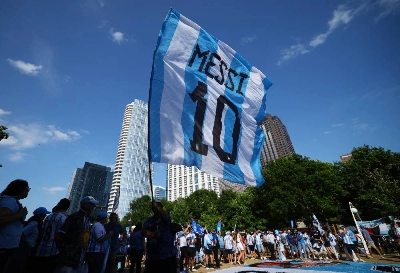
* Supporters packing stadiums and fan festivals * World Cup reminding Americans what they have been missing * But NFL's top spot will be hard to budge Evan Hand had seen viral sports moments before, but the one that changed how he understood soccer's reach did not come from a superstar. It came from Vozinha, Cape Verde's 40-year-old goalkeeper, whose seven-save performance in a goalless draw against heavily favoured Spain turned him into an overnight social media sensation. "The big moment for me was the Vozinha thing," said Hand, a sports content creator. "It was seeing this dude gain 15 million followers basically overnight playing for a team where if you were to look on a map, you could not tell me where Cape Verde is right now. "(NFL star) Tom Brady has less followers than this guy has, and he had arguably the most dominant run in the history of sports. So that was a moment for me." For many American sports fans, this World Cup has delivered a similar jolt. As fans from around the world pack stadiums, television audiences surge and U.S. supporters crowd fan festivals and sports bars, the tournament has offered a vivid reminder that soccer is not a niche sport trying to crack the American mainstream. It is the world's dominant game, and the United States is still catching up to its scale. The tournament is already on pace for record attendance. Through the first 44 matches, total attendance topped 2.85 million, with stadiums averaging about 99.6% capacity, according to a Reuters analysis based on FIFA data. Fox's broadcast of the U.S. win over Australia drew 16.2 million viewers, a figure likely to be surpassed as the Americans move into the knockout rounds. "I think for a lot of people who always thought the sport was boring, they're finding out that it's exciting," said Bob Dorfman, a sports marketing analyst. "And that is helping the game." GLOBAL PASSION The tournament's impact in the United States may be measured as much in emotion as ratings. Dorfman said American fans are being exposed not only to elite players, but to the passion of travelling supporters and immigrant communities who treat the World Cup as something closer to a national holiday than a sporting event. "In the United States, there's all these foreigners coming in or immigrants who are here that are just going nuts over it," he said. "And I think to some extent the U.S. citizens are a little jealous of the Scottish fans and the Brazilians. "I was watching the Brazil game yesterday and I had a lump in my throat watching them sing their national anthem. The emotion is huge. The excitement is huge. There's big stars playing that Americans are finally getting a closer look at." Hand said his World Cup videos are doing "leaps and bounds" better than his regular content that typically focuses on sports like college football and golf."It's not that we didn't know soccer was big," he said. "I don't think we knew the true scale of exactly how big soccer is. Every single person through the rest of the world, even if they're from some random town in Brazil or Siberia, they know soccer. And they love soccer and they will die for that game." U.S. ENTHUSIASM GROWING Outside Los Angeles Stadium before Thursday's U.S.-Turkey match, fans created a carnival atmosphere, singing songs, pounding drums and setting off red, white and blue smoke bombs. The success so far of the U.S. team in the tournament - winning their first two matches and topping their group - has spurred enthusiasm. Alicia Rutz, a former player dressed as Wonder Woman heading into the game with her husband, who came dressed as fictional coach Ted Lasso, said Americans have begun appreciating the sport's smaller details. "It's so fun to see Americans get soccer, love soccer," Rutz said. "They're cheering for not just goals, they are cheering for the right things - the right moves, the right touches, and it's so fun to see Americans adopt soccer and love it."Still, the idea of a soccer breakthrough in the United States is nearly as old as the modern American game itself. Hosting the 1994 men's World Cup, the growth of Major League Soccer and the success of the U.S. women's national team each brought predictions that the sport was ready to claim a permanent place beside the country's most powerful leagues. "We've seen this a lot of times in the U.S.," Rutz said. "But I think it could finally happen. Youth programs are taking off throughout the country and it could finally be something equivalent to NFL football, which I would love to see." WILL IT LAST? Soccer has a stronger U.S. foundation than in past generations: wider access to international broadcasts, a growing MLS footprint, a prominent women's game, Latino and immigrant fan bases, and a youth culture increasingly familiar with stars such as Lionel Messi, Cristiano Ronaldo and Christian Pulisic. Grassroots teams are attracting supporters, particularly in places where American professional leagues are lacking. But the American sports marketplace is crowded, and the NFL remains the country's dominant commercial force. "The NFL is the king here," Dorfman said. "They've done such a good job of dominating, and that's where all the attention is. The Super Bowl is the Super Bowl and even though the World Cup final is going to have 10 times the audience, this is a football country. I don't know that soccer is ever going to catch up to that." Hand is cautious, too. He sees a tournament capable of inspiring young fans, but not necessarily one strong enough to hold the national spotlight once football season returns. "I think that right now we are all very high on soccer," Hand said. "And there are thousands of little Timmys and little Emilys who are looking up to these icons like Messi, Ronaldo and Pulisic. They're saying, 'I want to be like them when I'm older'. "But at the same time, hundreds of thousands of these kids are still idolizing the Patrick Mahomes and the Arch Mannings and the Alex Ovechkins and the Caitlin Clarks." "By the time August rolls around and we have NFL preseason, Hard Knocks and college football Week Zero, people are going to mostly forget that this even happened." For now, though, the World Cup has done what generations of soccer evangelists in the United States have tried to do: make the scale of the sport impossible to ignore. The lesson for American fans may not be that soccer is finally becoming big. It is that it already was.


Select Section



Friday, June 26, 2026

Saturday, June 27, 2026

Sunday, June 28, 2026

Saturday, June 27, 2026

Thursday, June 25, 2026